
 By
·
4 minute read
By
·
4 minute read
A data center project rarely slips because one big thing goes wrong. More often, it slips because a dozen smaller workforce issues stack up at exactly the wrong time.
An electrical foreman is still trying to fill night-shift slots. A commissioning specialist is tied up on another site. Cable crews arrive, but the safety clearance process takes longer than expected. Meanwhile, the owner is pushing for turnover dates that cannot move.
That is what makes data center construction different from many other industrial builds. The margin for delay is thin, the sequencing is unforgiving, and the labor mix is highly specialized. When the right people are not on site at the right moment, schedule pressure shows up fast in overtime, rework, safety risk, and missed milestones.
For project managers, operations leaders, and industrial HR teams, the question is no longer whether labor availability matters. It is how to build a staffing strategy strong enough to keep critical projects moving.
Why Data Center Projects Put Unusual Pressure on the Labor Market
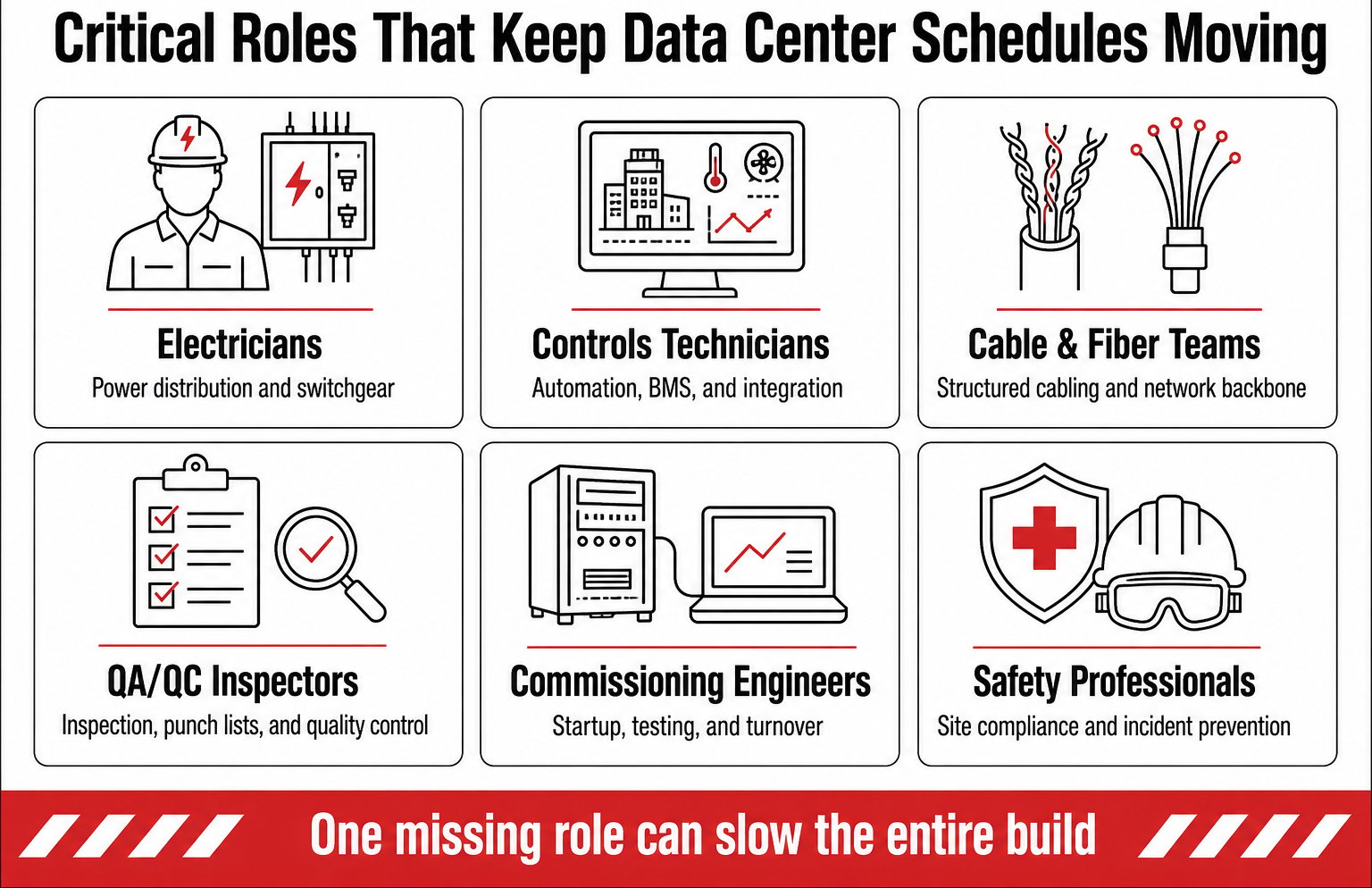
Data center construction sits at the intersection of several already-tight labor pools. You are not just hiring general construction talent. You are competing for electricians, controls technicians, QA/QC personnel, low-voltage teams, startup specialists, safety professionals, and supervisors who understand mission-critical environments.
That creates a real problem in the field.
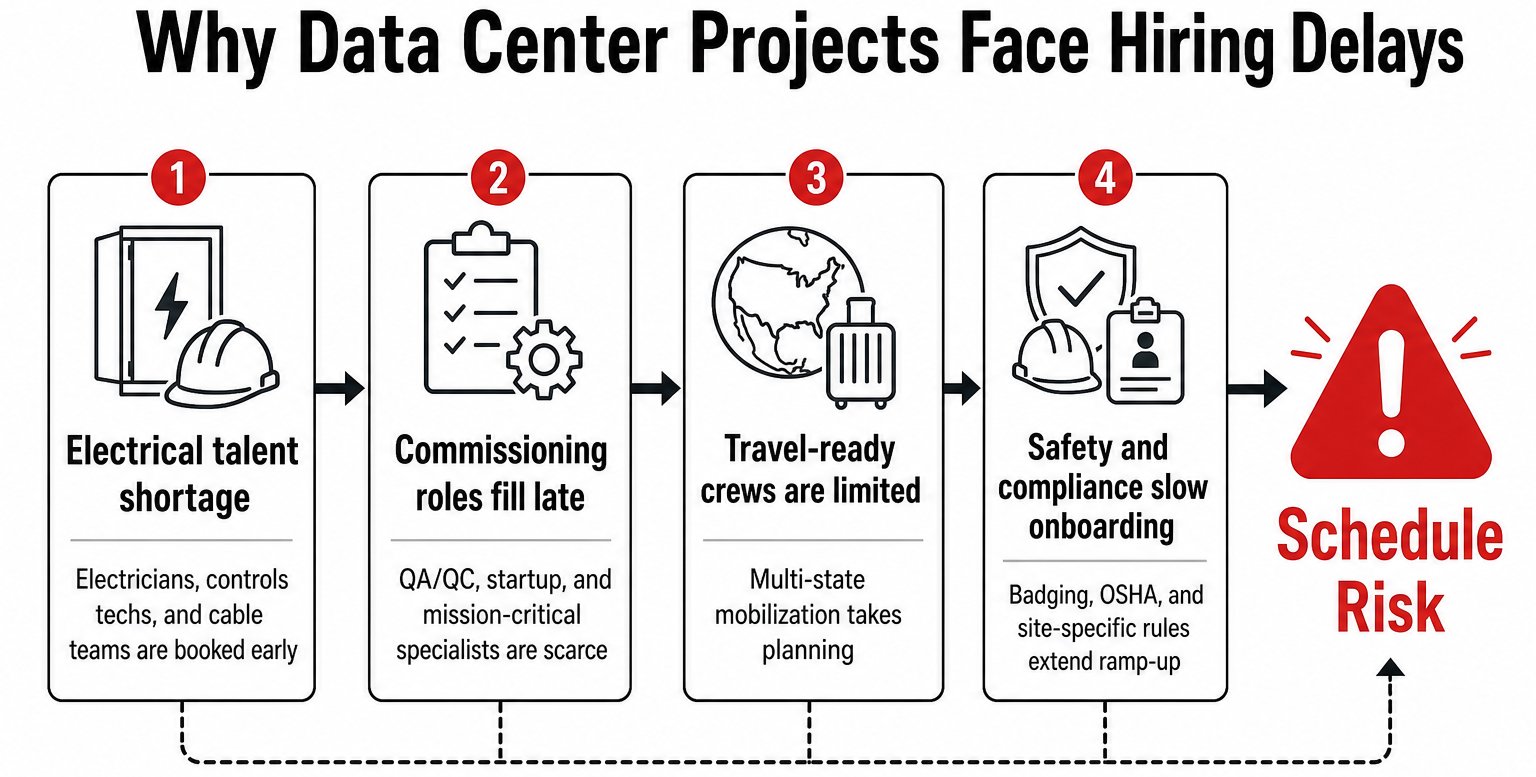
A contractor may have steel, equipment, and permits lined up. But if skilled electrical labor shows up late, the entire sequence behind it starts to compress. Crews get stacked on top of each other. Shift coordination becomes harder. Overtime increases. Quality issues creep in because teams are moving faster than the work allows.
In practical terms, data center labor shortages usually show up in four ways:
- Slower mobilization at project launch
- Gaps in specialized trades during peak phases
- Higher overtime and burnout during schedule recovery
- Delays in commissioning and owner handoff
For leaders responsible for delivery, that is not just a recruiting issue. It is an execution issue.
The Hidden Cost of Waiting Too Long to Staff
Many projects do not have a labor problem at bid stage. They develop one later because workforce planning was treated as a downstream task.
That is where the damage starts.
Schedule compression becomes expensive fast
When a project loses even two or three weeks on critical labor, the instinct is to recover with added shifts, weekend work, and rushed onboarding. Sometimes that works in the short term. Often, it creates new problems.
Fatigued crews make more mistakes. Supervisors spend time solving attendance gaps instead of managing production. Safety teams have to push harder to maintain standards. What looked like a simple staffing shortfall turns into a productivity problem across the entire site.
Specialized roles do not fill on demand
General labor can be difficult to find. Specialized industrial labor is harder. Mission-critical construction needs people who can operate in structured, high-compliance environments and still hit aggressive schedules.
If you wait until the project is under pressure to source those roles, you are already behind.
Project continuity suffers
Owners notice inconsistency. So do GCs and trade partners. When staffing is unstable, project rhythm breaks down. Handoffs get rougher. Coordination suffers. Confidence drops.
In industrial and mission-critical work, consistency matters almost as much as headcount.
What Smart Data Center Staffing Looks Like
The best staffing plans do not begin with resumes. They begin with phase planning.
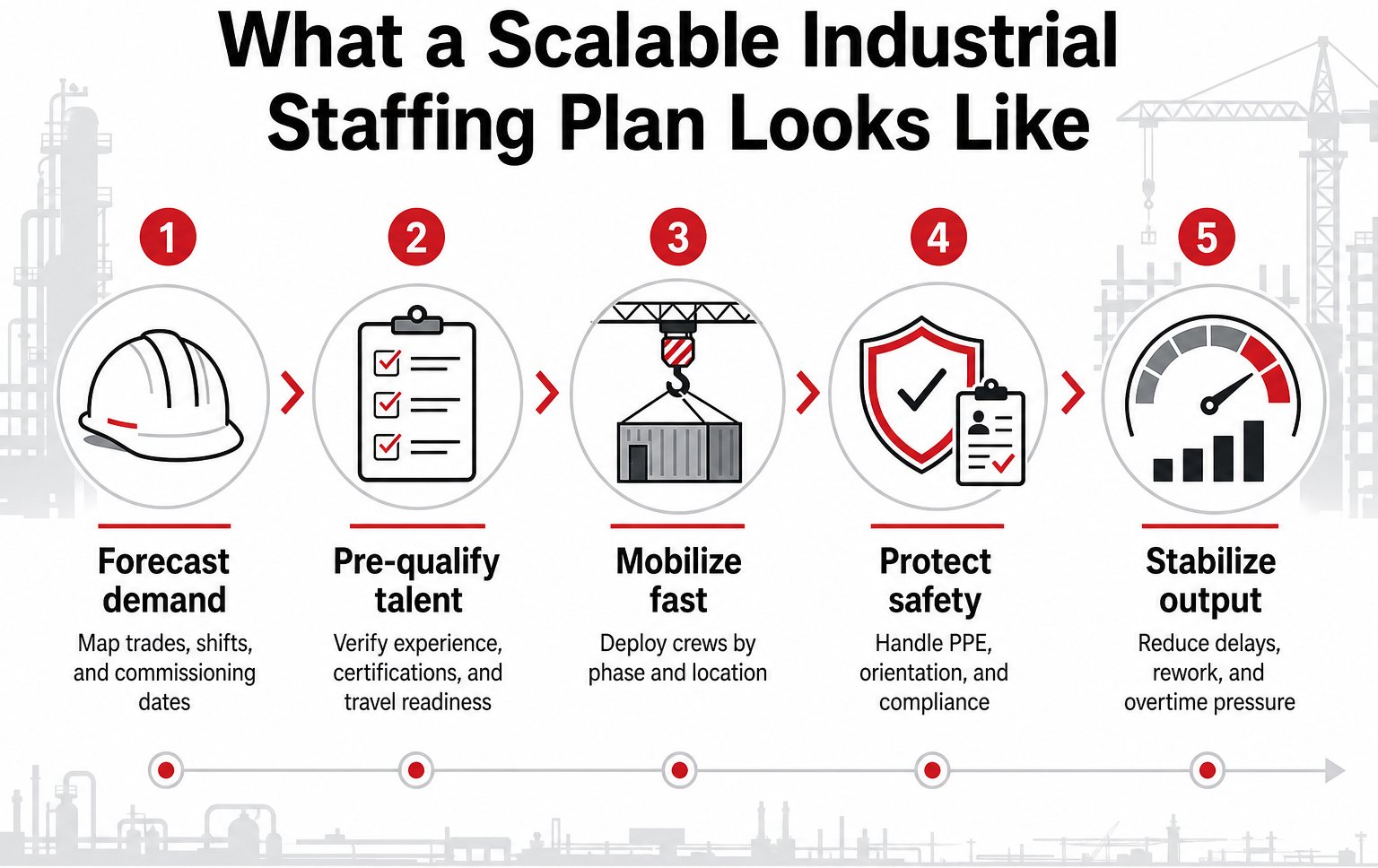
A strong industrial staffing strategy maps labor demand to the actual life of the project, not just the headcount target in the original estimate. It accounts for when each trade is needed, how quickly those workers must mobilize,the what certifications or site-readiness requirements apply, and where backup capacity will come from if demand changes.
Start with the build sequence, not the job titles
A job list is useful, but it is not enough. Leaders need to know when labor demand spikes, where sequencing creates bottlenecks, and which roles can hold up downstream work.
On a data center build, one missing group of electricians or controls technicians can affect multiple follow-on trades. That is why labor planning has to mirror the project schedule, not sit beside it.
Build a travel-ready, compliance-ready workforce bench
The best staffing partners do more than send names. They help build a deployable workforce.
That means candidates are screened not only for technical skill, but also for:
- Relevant industrial or mission-critical experience
- Travel availability or relocation flexibility
- Safety readiness and documentation
- Ability to work specific shifts or compressed schedules
- Reliability in structured, deadline-driven environments
This matters because the time lost in re-vetting, replacing, or re-onboarding workers can be just as costly as the time spent sourcing them.
Stay flexible without losing control
One of the biggest mistakes on fast-moving industrial projects is assuming the original labor forecast will hold. It rarely does.
Equipment schedules shift. Scope expands. Another trade falls behind. A site suddenly needs more night work. When that happens, rigid workforce models struggle.
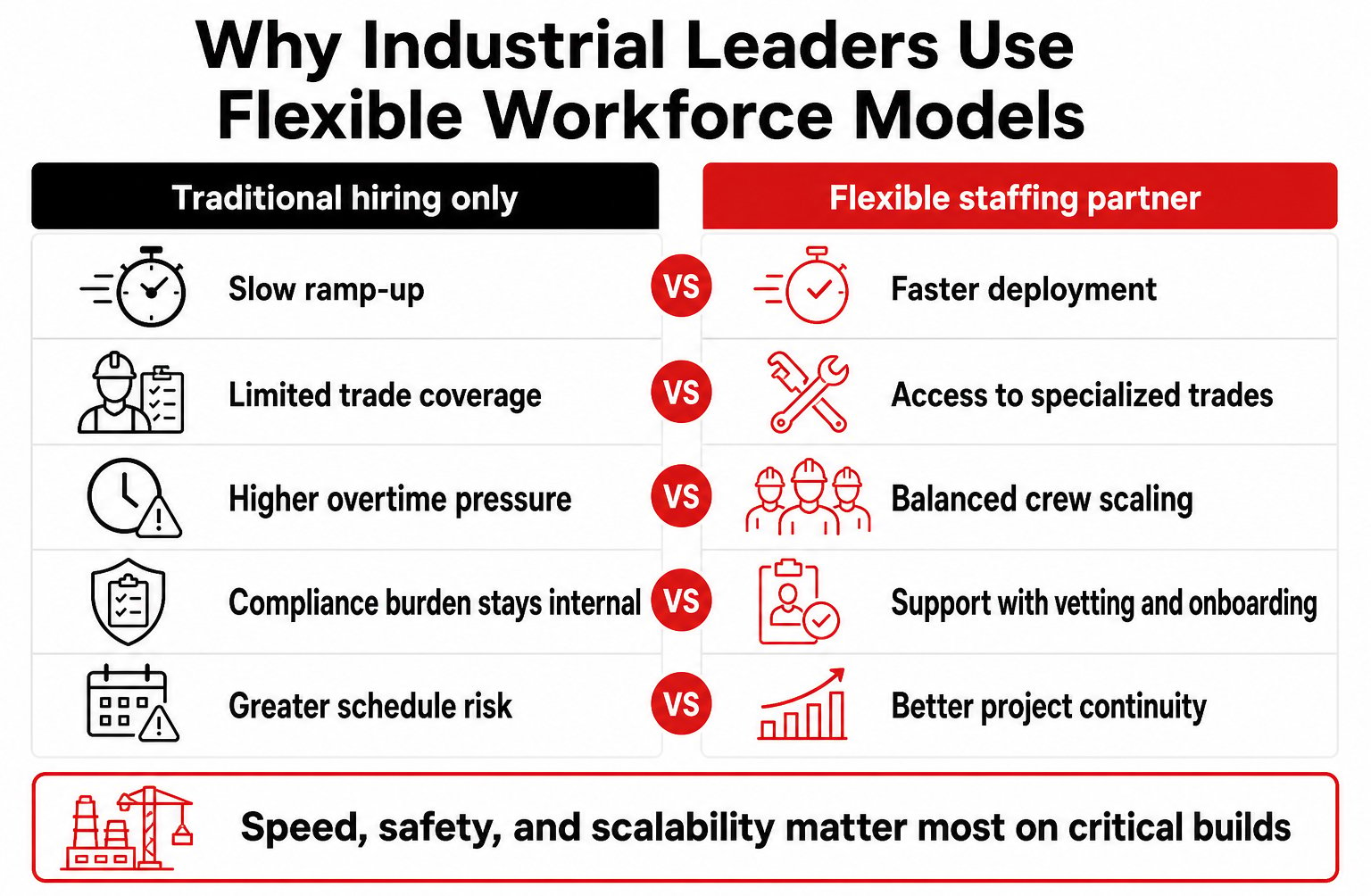
Flexible staffing does not mean reactive staffing. It means having a partner and a process that let you scale up or rebalance crews without losing visibility, safety discipline, or quality expectations.
Why the Right Staffing Partner Changes the Outcome
Industrial staffing is not valuable because it fills open seats. It is valuable because it reduces operational friction.
The right workforce partner helps project leaders solve for speed, reliability, and fit at the same time. That includes understanding the difference between a candidate who looks qualified on paper and one who can actually succeed on a high-pressure industrial site.
For data center and heavy industrial work, that distinction matters.
A strong staffing partner should be able to support:
- Skilled trades and supervisory hiring across phases
- Multi-site or multi-state workforce scaling
- Fast-response hiring for schedule recovery
- Safety-conscious onboarding and workforce vetting
- Coverage across adjacent sectors such as substations, renewables, automation, and commercial construction
That broader sector reach matters because workforce demand does not stay inside one vertical. Data centers compete with power projects, manufacturing work, and other industrial builds for many of the same people.
A Real-World Scenario Leaders Recognize
Consider a project approaching its electrical and commissioning peak. The owner is fixed on turnover. The GC is tracking every milestone daily. The schedule leaves no room for a slow labor ramp.
Now imagine the project is short on experienced controls technicians and QA/QC support. Electricians are available, but not at the pace needed. The result is predictable: punch work grows, testing slips, supervisors get pulled into coverage problems, and turnover risk climbs.
That is the moment when staffing stops being an HR function and becomes a business-critical lever.
The projects that recover best are usually the ones that already have a scalable labor strategy in place. They know where backup talent can come from, how quickly crews can mobilize, and what tradeoffs they are willing to make before the schedule is at risk.
The Bottom Line
Data center construction is moving too fast, and labor is too specialized, for workforce planning to remain an afterthought.
If project leaders want to protect schedule, safety, and quality, they need staffing strategies built for real industrial conditions: phased demand, specialized trades, compliance pressure, and rapid change. The goal is not simply to hire faster. It is to create a workforce model that keeps projects stable when conditions get tight.
That is where the right industrial staffing partner makes a measurable difference.
N2S Industrial helps companies build reliable, scalable workforces across data centers, heavy industrial, automation, renewable energy, and construction environments where timing and talent both matter. When the project is critical, workforce planning has to be just as precise as the build itself.